
How to Rotate your Tires
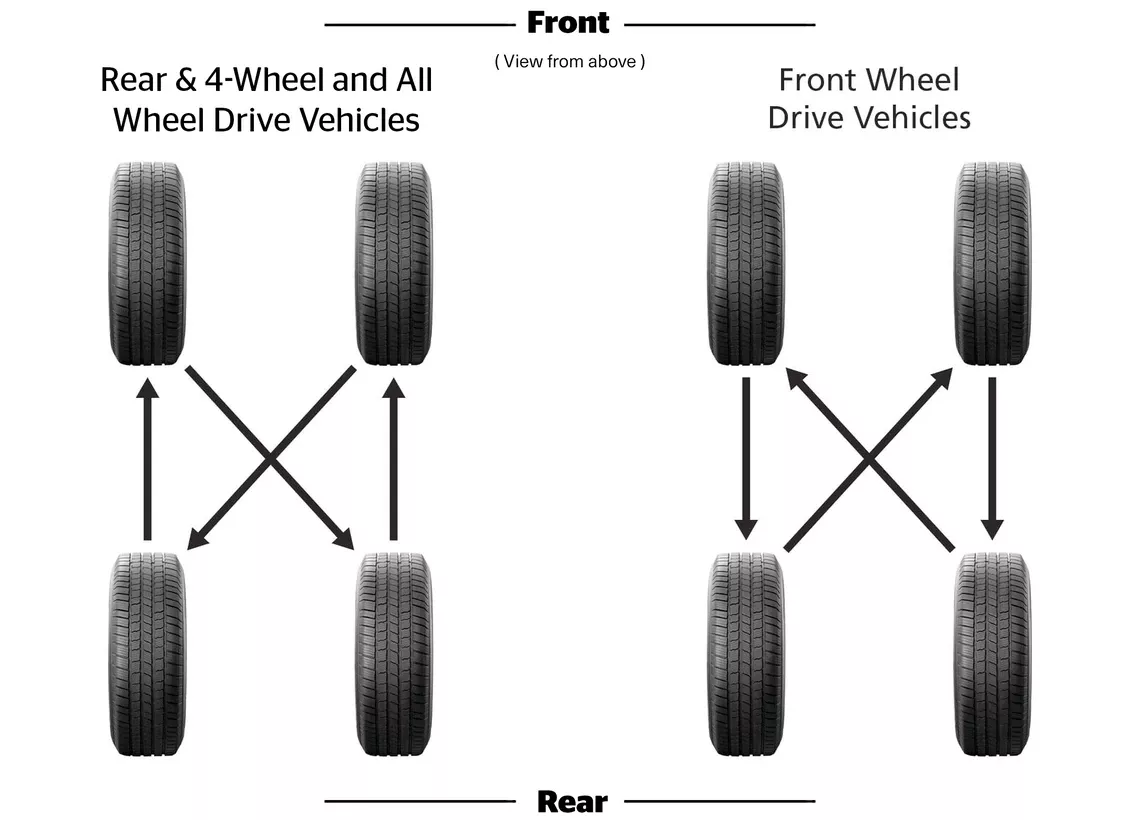
Rotating your tires is an important part of vehicle maintenance that can help to prolong the life of your tires and improve the performance of your vehicle. Here are step-by-step instructions on the proper way to rotate tires for both front-wheel drive and four-wheel drive vehicles:
Front-Wheel Drive Vehicles:
Begin by lifting the front of the vehicle using a jack or a pair of jack stands. Make sure the vehicle is securely supported before you begin working on it.
Remove the lug nuts from the front tires using a lug wrench. Carefully remove the tires/wheels from the front of the vehicle.
Move both front tires/wheels directly to the back of the vehicle and install them on the rear Make sure to properly align the tires on the wheels and securely fasten the lug nuts.
Move the passenger rear tire/wheel to the drivers front and the drivers rear tire/wheel to the passenger front of the vehicle. Make sure to properly align the tires on the wheels and securely fasten the lug nuts.
Lower the vehicle back to the ground and check the tire pressure on all four tires. Make sure they are properly inflated to the recommended pressure as specified by the vehicle's manufacturer.
Finally, check the alignment, and if needed, get it checked by a qualified technician.
Four-Wheel Drive Vehicles:
Begin by lifting the vehicle using a jack or a pair of jack stands. Make sure the vehicle is securely supported before you begin working on it.
Remove the lug nuts from all four tires using a lug wrench. Carefully remove all four tires/wheels from the vehicle.
Move the rear tires/wheels directly to the front of the vehicle. Make sure to properly align the tires on the wheels and securely fasten the lug nuts.
Move the driver side front tire/wheel to the passenger side rear, and move the passenger side front tire/wheel to the driver side rear of the vehicle.
Lower the vehicle back to the ground and check the tire pressure on all four tires. Make sure they are properly inflated to the recommended pressure as specified by the vehicle's manufacturer.
Finally, check the alignment, and if needed, get it checked by a qualified technician.
It's important to note that the frequency of rotating tires can vary depending on the type of vehicle and the driving conditions. It's recommended to check the owner's manual or consult with a mechanic to determine the appropriate rotation schedule for your vehicle. Additionally, make sure to check the tire's wear and replace them if needed, to ensure safe driving.